 EVE AI Core
The Infrastructure of No.
EVE AI Core
The Infrastructure of No.
Deploy CoreGuard inside your environment for pre-execution policy enforcement, cryptographic evidence, and independently verifiable decisions.
Purpose-built for on-premises, private-cloud, air-gapped, and sovereign environments.
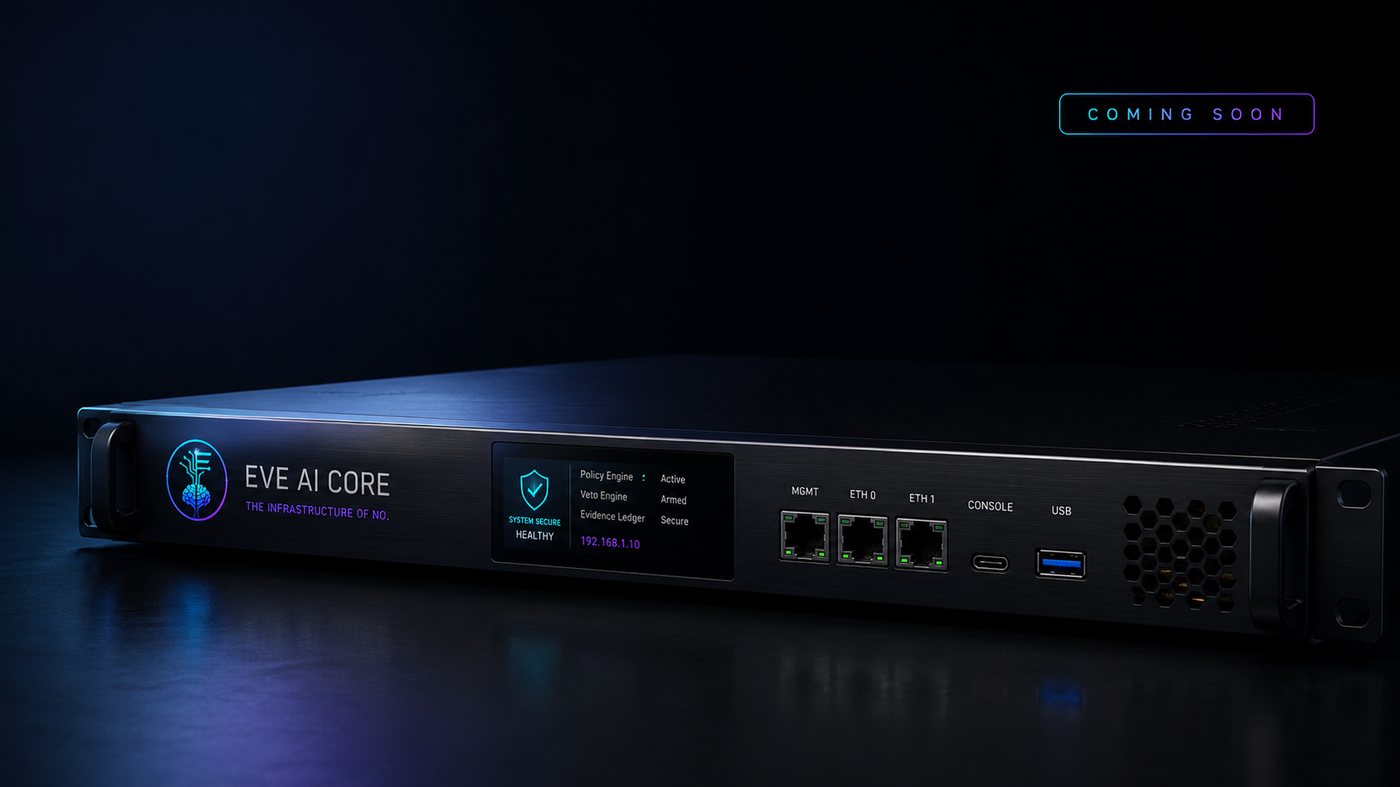
The EVE CoreGuard Appliance is being designed to place deterministic AI policy enforcement directly inside enterprise infrastructure. It evaluates proposed model and agent actions before execution, applies explicit policy, and produces cryptographically verifiable evidence for every governed decision.
A concept look at the planned 1U chassis — front panel, status display, network interfaces, and rear I/O. Configuration and appearance are preliminary and subject to change.
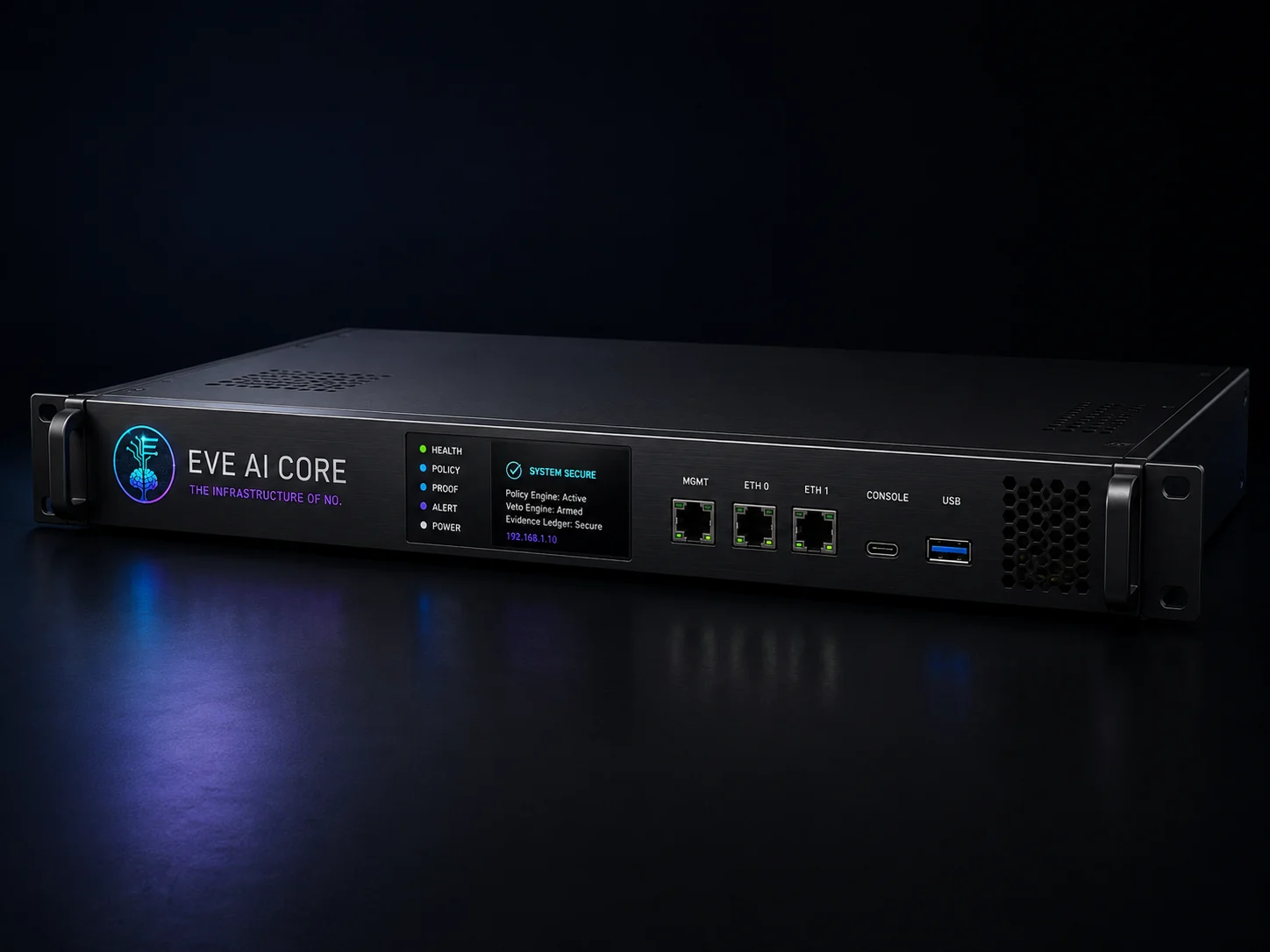
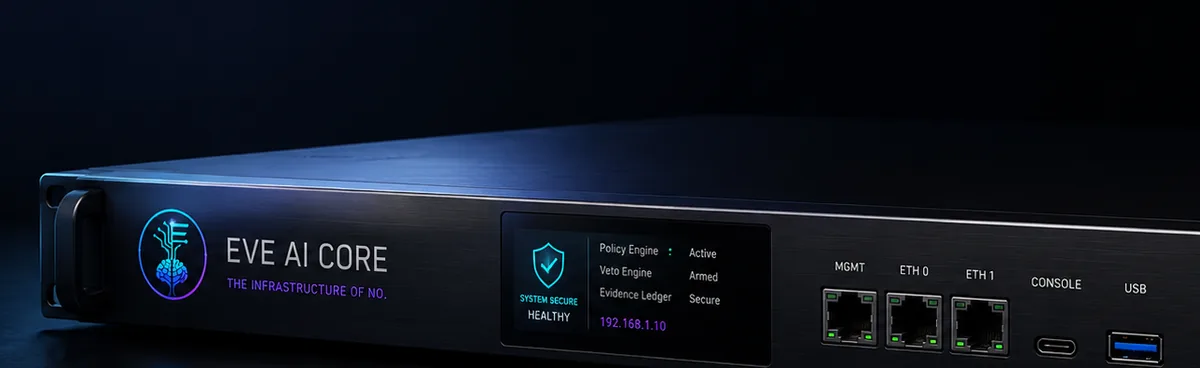
Concept product renders. The EVE CoreGuard Appliance is currently in development; final appearance, ports, and configuration may change.
The appliance is designed to deliver the EVE CoreGuard enforcement runtime and EVE Proof evidence layer as a customer-controlled deployment. Capabilities below describe the governance surface the appliance is intended to package; final hardware behavior depends on the selected configuration.
Evaluates proposed actions against explicit rules before execution and returns an enforceable ALLOW, MODIFY, or BLOCK decision.
Places governance before consequential model output, agent actions, tool calls, or external execution.
Screens for instruction hijacking, system-prompt extraction, adversarial tool use, and related attack patterns.
Evaluates whether an action's stated purpose matches the tool, data, destination, and requested operation.
Detects or restricts sensitive personal information, credentials, secrets, and protected data according to policy.
Applies versioned, testable, deterministic governance policies across models, agents, tools, and workflows.
Produces signed decision certificates that can be independently verified.
Maintains ordered governance evidence suitable for investigations, audit review, and control validation.
Allows authorized parties to verify evidence without relying on the original runtime service.
Applies the same enforcement boundary across probabilistic models, autonomous agents, and tool-enabled workflows.
Restricts where protected information, requests, actions, and evidence may be processed or stored.
Surfaces policy status, evidence status, runtime health, and enforcement readiness.
Deploy within customer-controlled facilities and networks.
Operate inside isolated enterprise cloud environments.
Support environments that restrict or prohibit external network access.
Keep enforcement and governance evidence within required jurisdictions or controlled infrastructure.
Integrate with security, compliance, model-risk, and audit workflows.
All specifications below are preliminary design targets and subject to change. No component models, capacities, throughput figures, port counts, certifications, or availability dates are implied or finalized.
The appliance is not an unrelated hardware product. It is a planned deployment option for the same governance platform that runs today as software — the enforcement runtime and its evidence layer, packaged for customer-controlled infrastructure.
The deterministic pre-execution enforcement runtime. Explore CoreGuard →
The cryptographic evidence, certificate, verification, and decision-lineage layer. Explore EVE Proof →
The planned physical deployment option for organizations that require customer-controlled, on-premises, air-gapped, or sovereign infrastructure.
The appliance is the hardware deployment of the same governed runtime. This buyer / evidence packet documents how EVE CoreGuard enforces deterministic, fail-closed AI governance today — and how the veto engine is designed for FPGA and future silicon integration. It states only what is true today.
What is implemented today, what is software-enforced, what is FPGA-compilable, what requires customer hardware, the architecture and threat model, a signed decision-certificate sample, replay and Nitro-attestation verification, the FPGA/silicon roadmap, a buyer-safe FAQ, and patent/IP positioning.
Public PDF · 15 pages · no signup required
Low-level integration material (veto_core.c, veto_interface.h, interlock protocol, hardware-attestation runbook, test vectors, and the FPGA/silicon SOW) is provided only under NDA via the Partner Kit.
Request early access.
Complete an environment and requirements assessment.
Select the appropriate deployment configuration.
Review licensing, security, and support requirements.
Schedule implementation and validation.
Begin controlled deployment.
Join the early-access program for organizations evaluating on-premises, private-cloud, air-gapped, or sovereign AI governance enforcement. Drop your work email and we'll be in touch.